
rest: my case

Lauren Keyana Palmer (we know her as Keke Palmer) stood on a TED stage in May 2026, and reintroduced herself to the world by her birth name. The talk is 12 minutes. I urge you to carve them out before you keep reading.
You’re back? Great. Let’s talk about rest.
I, like Lauren and I imagine many of you, have an uncomplicated relationship to rest.i.e. I don’t do it. That’s it.
My therapist would go as far as to prescribe me “rest” and I would retort: but what exactly do you mean? Is it sleep? I sleep at 9pm and my sleep score (I say, proudly) is consistently over 80. I imagine a few of you are going to roll your eyes, tell me how lucky I am, and stop reading at this point. Fair enough.
What comes with those seven or eight glorious hours are vivid dreams, usually lucid ones, and a speed-racing brain. I write pitches in my sleep, and because I’m lucid, I wake myself up to take notes because it was THAT good (my dear reader, it is never good). I wake up feeling unrested, I drink a cup of coffee, and off we go.
Sleep and rest are not the same thing. Treating them as synonyms is how you end up technically recovered and functionally depleted.

(I googled photos of women in rest and this is what I found)
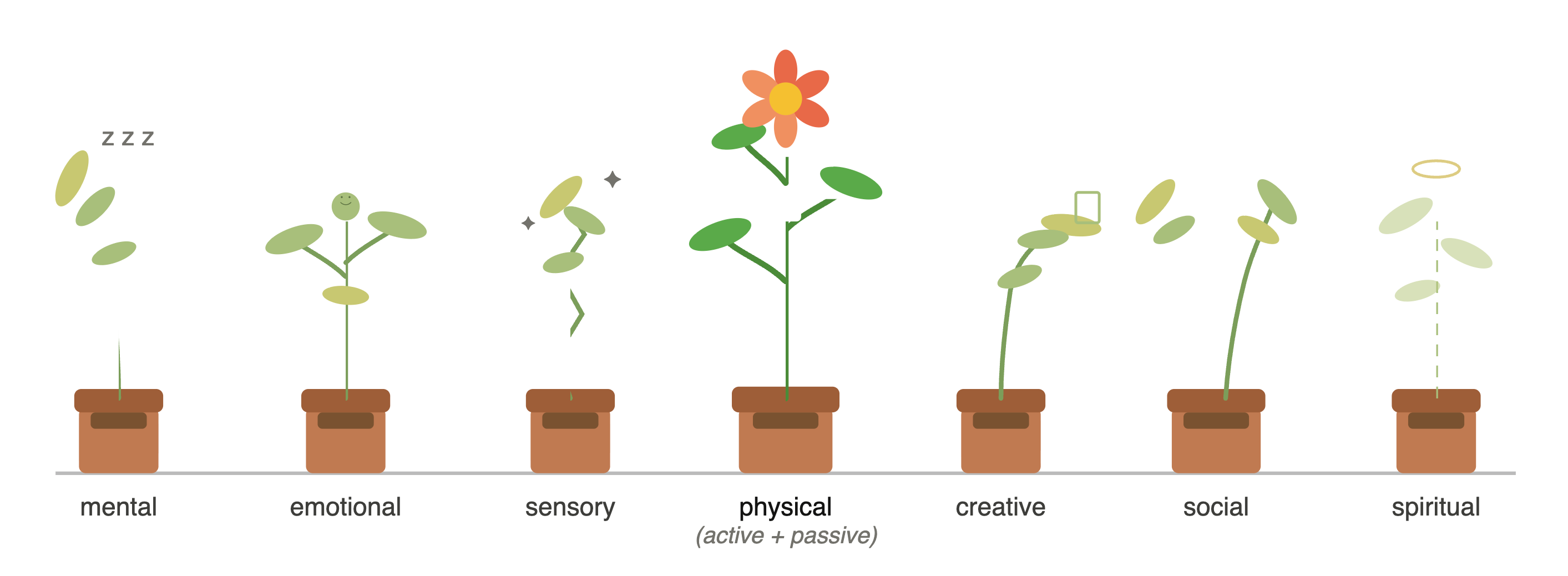
Dr. Saundra Dalton-Smith spent years watching patients arrive exhausted despite logging adequate sleep. Her conclusion: sleep addresses exactly one of seven types of rest the body needs: passive physical rest. The others are active physical rest, mental rest, emotional rest, sensory rest, creative rest, social rest, and spiritual rest. You can be getting eight hours of sleep and running a deficit in all six others simultaneously. Which is, I suspect, the dominant condition of modern professional life.
Run the list on yourself. Mental rest is what you’re not getting when your thoughts narrate you to sleep. Sensory rest is what the nervous system is begging for after a day of open offices and Slack notifications and other people’s ambient stress. Emotional rest means time when you’re not performing, not managing, not holding it together, not reading the room. Creative rest is permission to receive beauty without immediately converting it into content.
The only time I feel wholly, uncomplicatedly rested is after a long surf session. Two-three hours where my body is working hard enough that my brain finally runs out of things to say. I stop narrating and something in me just receives. Which raises the question I cannot shake.
Why does it take full physical depletion to get there? Why is exhaustion the only door?
The doors we know are societal, cultural. But what I want to examine here is the door of theology. Most cultural and religious traditions have their own version of this. This is just the one that lives most loudly in me and many Indians I know: the shorthand passed down is simply, that’s cute, but you can sleep when you’re dead.
I am not a Bhagavad Gita scholar (gosh, not even close!) but the source text poses a question that I think shapes modern life in ways in interesting ways. A loose translation of a relevant passage: “You have the right to work, but never to the fruit of work. Let not the fruits of action be your motive, nor let your attachment be to inaction.” Both attachments are named - to outcomes, and to inaction. The commentarial tradition goes further, treating inaction born of lethargy, tamas, as a kind of spiritual failure.
So here’s what I wonder: in a framework where action is the moral default and inaction requires justification, what happens to rest? Add seva - selfless service, duty that extends outward to family, community, the world - and you have a system in which stopping, for its own sake, has no obvious home.
I want to be careful here because you of course can’t take things out of context, and I find these notions of karma genuinely beautiful: work as devotion, effort without ego, acting because the action is right rather than because of what you’ll get. I’m not critiquing the philosophy. I’m just asking what happens when these teachings get handed down, perhaps even sanded down, across generations.
Does it produce people who are very good at doing and genuinely confused by the instruction to stop?
So this is not a wellness problem or a sleep debt issue. It’s a theology problem. And you cannot solve a theology problem with a temperature-controlled mattress.
A detour: studies consistently show more than two thirds (some estimates as high as 80%!!) of autoimmune disease diagnoses are in women, across lupus, rheumatoid arthritis, multiple sclerosis, and hundreds of others. Researchers point to estrogen, X chromosome biology, the more powerful immune response women carry that protects against infection but raises the risk of the immune system eventually turning on itself.
The narrative I’ve heard and personally subscribe to is the variable harder to measure in a lab. What is the cumulative physiological cost of performing at the level most women perform — the emotional labor, the sensory load, the never quite turning off?
In her TED Talk (which you’ve watched so you know!), Lauren Palmer talks about spending 23 years running a character designed to hold everything together without alarming anyone. I’m sure many here can relate. I certainly can. These are not personality traits. They may be health events accumulating in slow motion. The body will tell you. Maybe you catch it in time. Maybe you don’t.
I wrote a set of principles I call biotending: a framework for how I want to nourish myself and live in this life. Rest is a principle, but until recently, I couldn’t even tell you what that meant!
Rest is not a privilege allocated to the lucky, earned by the productive, and accessed only after you’ve done enough. It is the baseline. What our bodies are still asking for, in a language we’ve mostly stopped listening to.
I’m writing to you from inside a sunny conservatory, in a blisteringly hot London, eating a mackerel on sourdough from a space of rest. My only KPI at the moment is to find ways to fill all my little underwatered rest plants.
I literally don’t know anyone who won’t benefit from reading this!